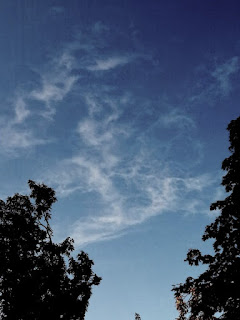
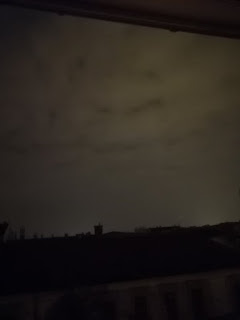
I took this "Messiah" photograph on May 19, 2025, in Budapest during a season of spiritual anticipation shared by both Jewish and Christian traditions. The image has been rotated by 90 degrees.
In Judaism, it fell during the Counting of the Omer, the sacred journey toward Shavuot and the remembrance of the revelation at Mount Sinai.
In Christianity, it occurred during the Easter season, a period of reflection on the Resurrection and preparation for Pentecost and the coming of the Holy Spirit.
This was not the first time I had captured cloud formations that appeared to resemble recognizable faces or figures. Over the years, I have taken a number of similar photographs, illustrating a phenomenon known in psychology as pareidolia, the human tendency to perceive meaningful patterns, especially faces, in random or ambiguous visual forms.
The image also evokes themes found in Jewish mystical tradition concerning Enoch and Metatron, sometimes referred to in the Hekhalot literature and the Book of 3 Enoch as the "Lesser YHWH." According to this tradition, the righteous patriarch Enoch was transformed into the exalted angelic being Metatron, the Prince of the Divine Presence and heavenly vice-regent.
While Enoch and Metatron represent different states of existence human and celestial they are understood within this mystical framework as the same being before and after his heavenly transformation. Metatron is portrayed as the youngest among the highest heavenly beings, uniquely privileged to stand before the Divine Presence and entrusted with authority as God's chief representative.
Whether viewed as a striking example of pareidolia, as an artistic coincidence, or as a symbol open to deeper personal interpretation, the image emerged during a time that both Jewish and Christian traditions associate with reflection, transformation, and openness to divine revelation.
An offering created in meditation through the power of mantras and prayer.
As our beloved Lama Ole Nydahl rests in deep peace, radiating strength even as his physical presence fades, we hold the space for him and all sentient beings.
May the light of the Diamond Mind remain boundless. 🙏
On July 13, 2026, in Budapest’s Rózsák tere (Square of Roses), I captured a photograph that became a significant milestone in a spiritual process years in the making.
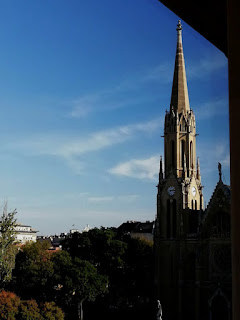
This square is a profound spiritual intersection. Even Pope Francis visited the site to meet with the poor and refugees. It serves as a literal crossroads of faiths: at its center stands the neo-Gothic Church of St. Elizabeth of the House of Árpád, neighboring a Greek Catholic Church. The square also hosts the Diamond Way Buddhist Community center.
Running through it is Dohány Street, which anchors the Great Synagogue at one end and a smaller synagogue at the other, while the Fasori Lutheran Secondary School dormitory also stands on the square.
For years, I have experienced phenomena that, for me, go beyond simple coincidence. I see formations in the clouds recurring “profiles” that do not feel random. I document these regularly, alongside daily synchronicities: repeating numbers, specific timings, and events that seem to align with an unusual precision.
At a certain point, these experiences began to enter into a dialogue with my earlier research.
Years ago, I encountered the work of James D. Tabor, an internationally recognized biblical scholar at the University of North Carolina, who for decades conducted archaeological research in Israel. His work opened for me the world of early Christianity and Second Temple Judaism in a way that felt alive and immediate.
His book The Jesus Dynasty was not just historical reading it became a doorway.
Alongside this, the investigations of Simcha Jacobovici, especially his documentaries on the Talpiot Tomb deepened this path further. What began as intellectual curiosity slowly became something personal. This eventually led me to Jerusalem, where I visited the Talpiot Tomb myself.
Cement shaft and lid of
Talpiot Tomb / Jesus Family Tomb
A Dialogue with Ancient Texts
The “double profile” I observed in the clouds did not appear in isolation. It resonated with something I had encountered years before in ancient texts.
In the Parables of Enoch (1 Enoch 37–71), the figure of the “Son of Man” emerges with striking clarity far beyond a simple human figure.
Pre-existence (1 Enoch 48:2–3):
“Before the sun and the signs were created… his name was named before the Lord of Spirits.”
Light of the nations (1 Enoch 48:4):
“He will be a light to the nations… and a hope to those who are troubled in heart.”
The throne of glory (1 Enoch 62:2,5):
“The Lord of Spirits seated him on the throne of his glory…”
“…and fear shall seize them when they see the Son of Man sitting on the throne of his glory.”
Communion with the righteous (1 Enoch 62:13–14):
“…they shall dwell with that Son of Man… and eat and lie down and rise with him forever.”
Bearer of hidden wisdom (1 Enoch 49:3–4):
“In him dwells the spirit of wisdom… and he will judge the hidden things.”
These passages feel astonishingly close to the New Testament image of the glorified Christ.
In the Book of Daniel (Daniel 7:9–14), the vision appears in a more primordial form:
“His clothing was white as snow, and the hair of his head like pure wool…” (Ancient of Days)
“And behold, with the clouds of heaven there came one like a son of man…”
Here, the “Son of Man” approaches the “Ancient of Days.”
But in Enoch, he is already beside Him—enthroned, judging, eternal.
This same imagery reappears in the words of Jesus:
“When the Son of Man comes in his glory… then he will sit on his glorious throne.” (Matthew 25:31)
The parallels are too strong to ignore.
A Wider Tradition
The “Son of Man” is not limited to a single text.
It appears across ancient Jewish tradition:
In 1 Enoch: a pre-existent, heavenly judge
In 4 Ezra (2 Esdras) 13: a figure rising from the sea, “like a man,” destroying armies and gathering the people
In the Dead Sea Scrolls: fragments reflecting similar messianic expectations
In later rabbinic tradition: often identified with the coming Messiah
Between Daniel and Enoch, something shifts.
In Daniel, the figure receives authority.
In Enoch, he already possesses it.
The Image Itself
Son of Man / Click on to enlarge
In the photograph I took, two profiles appear:
An older, bearded figure, with closed or withdrawn expression
A younger Son of Man beside it
This immediately brought to mind the central scene of Daniel 7 and the Enochic visions:
The Ancient of Days: “hair like pure wool” (Daniel 7:9)
The Son of Man: present beside Him (1 Enoch 46:1)
The contrast is striking:
Hidden vs. revealed
Silent vs. speaking
Transcendent vs. relational
The closed eye of the older figure feels like mystery depth, hiddenness.
The younger profile seems to face outward toward humanity.
The Prophecy and the Mystery of Identity
The figure of the Son of Man originates in the Book of Daniel (Chapter 7) and is expanded upon in the Book of Enoch ancient texts that Jesus himself almost certainly studied and referenced. In these visions, the Son of Man is a cosmic judge who appears alongside the Ancient of Days.
From a prophetic perspective, the appearance of these two figures together, whether as a vision or a sign represents the fulfillment of these ancient descriptions, regardless of the specific identity of the figure. While Christian tradition identifies the Son of Man as Jesus appearing with the Father, the ancient texts maintain a certain mystery:
In the Book of Enoch, the "Son of Man" is sometimes revealed to be the patriarch Enoch himself, elevated to a divine status as a heavenly scribe and judge.
In Daniel, the figure is "one like a son of man," appearing as a symbolic representative of the righteous who receives an eternal kingdom.
This means that the "vision" or "sign" of the double profile fulfills the structure of the prophecy itself. It depicts a divine hierarchy where a visible, human-like Savior acts in unison with the invisible, eternal Source. Even if the exact identity of the Messiah remains a point of theological debate or a "hidden" mystery, the pattern of their joint appearance serves as a sign that the era of judgment and revelation as foretold by the prophets is present and active.
Synchronicity
At this point, I cannot ignore the idea of synchronicity as described by Carl Gustav Jung. These are not just coincidences, but meaningful alignments inner and outer events reflecting one another. The image, the date, the texts, the earlier research, the journey to Jerusalem they do not feel causally connected.
And yet, they form a pattern.
The Spiritual Weight of the Moment
July 13 carries its own resonance:
The third apparition at Fátima in 1917
The tradition of the Archangel Gabriel as messenger
The Jewish period of mourning in Tammuz
These layers do not explain the experience but they deepen it.
Visual Theology
What appeared in the clouds felt like a form of “visual theology.”
A living image of something ancient:
The unity and distinction between:
the hidden source (Ancient of Days)
and the revealed presence (Son of Man)
Not as doctrine, but as image.
Not as proof, but as encounter.
From Seeing to Creating
This process did not remain external.
Through meditation and automatic painting, I began to create. Figures emerged without intention forms that echoed biblical imagery. These works feel less like drawings and more like traces of something unfolding internally.
An Open Question:
I do not claim certainty.
There is always the possibility of pareidolia.
There is always the psychological explanation.
But something remains.
A question:
Is it possible that the same patterns described in ancient texts are not locked in the past but can still appear, in symbolic form, in the present?
Not because history repeats itself, but because the structure of perception and perhaps something beyond it remains the same.
The photograph I took at Rózsák tere is not proof.
It is a sign.
A moment where something ancient seemed to look back.
If you'd like to learn more about James D. Tabor or the Talpiot Tomb, you can search for his name on Google or watch Simcha Jacobovici’s documentary on the subject.
Here are some helpful links to get you started:
James Tabor’s Official Website/Blog:jamestabor.com
The Jesus Discovery (Official site for the research):thejesusdiscovery.org
Several documentary episodes and series by Simcha Jacobovici and James Tabor regarding the Talpiot Tomb and related archaeological findings are available on YouTube.
The Lost Tomb of Jesus
This is the main documentary co-produced by James Cameron that initially brought the Talpiot Tomb to global attention.
Full Documentary: You can find full-length versions hosted on channels like I Love Docs and Unearthed History.
The Jesus Discovery / Resurrection Tomb
A follow-up documentary that explores a second tomb nearby using a robotic camera.
James Tabor’s "Jesus Archaeology" Series
Dr. Tabor has a more recent and academically focused series on his own YouTube channel.
Jesus Archaeology Playlist
: Over 40 videos where he narrates the "Jesus Story" through the lens of material evidence, including the Talpiot tombs.
Key Episode: Ten Jerusalem Tombs from the Time of Jesus provides context on how these tombs were used and discovered
Today isPalm Sunday, a day that historically marks the humble entry of the King of Peace into Jerusalem. Yet today, Israel is shrouded in the darkness ofwar. The sacred sites, usually echoing with the footsteps of pilgrims, stand silent and closed.
Zechariah 9:9 is a pivotal Messianic prophecy in the Hebrew Bible that describes the humble arrival of a righteous king to Jerusalem. It is most famous for its New Testament fulfillment during Jesus' "Triumphal Entry" into Jerusalem on Palm Sunday.
Interpretations
Christian Interpretation: Viewed as a direct prophecy of Jesus Christ. Matthew (21:4–5) and John (12:14–15) explicitly quote this verse to explain why Jesus rode a donkey into Jerusalem.
It highlights the "already but not yet" nature of his kingdom: he has come in humility (v. 9), but his universal reign of peace (v. 10) is still anticipated.
Jewish Interpretation: Traditionally understood as referring to the Messiah ben David. The Talmud (Sanhedrin 98a) notes that if Israel is worthy, the Messiah will come with the "clouds of heaven," but if unworthy, he comes "lowly and riding upon a donkey".
Some modern Jewish critiques argue the prophecy remains unfulfilled because universal world peace has not yet been established
Rejoice greatly, O daughter of Zion; shout, O daughter of Jerusalem; behold, thy king cometh unto thee; he is triumphant, and victorious, lowly, and riding upon an ass, even upon a colt the foal of a she-ass.
In the Sefaria system (and the JPS translation it uses), the term "she-ass" is the formal equivalent for a "jenny" (a female donkey), while "ayir" is translated as "colt" or "jackass" (a young male donkey).
Rashi’s Commentary on Zachariah 9:9
גילי מאד. א"א לפתור המקרא הזה אלא על מלך
המשיח שנאמר ומשלו מים עד ים ולא מצינו מושל כזה בישראל בימי בית שני:
Rejoice greatly. It is impossible to interpret this verse except as referring to the Messianic King, for it is said: "And his dominion shall be from sea to sea," and we do not find such a ruler in Israel during the days of the Second Temple.
עני ורוכב על חמור. ממדת ענוה:
Lowly and riding upon an ass. Out of a sense of humility.
New testament
The Gospel of Matthew (21:1–7)
The Gospel of John (12:12–16)
The Coming King of Zion
Rejoice greatly, O daughter of Zion!
Shout aloud, O daughter of Jerusalem!
Behold, your king is coming to you; righteous and having salvation is he, humble and mounted on a donkey, on a colt, the foal of a donkey.
A Vision of Compassion on Palm Sunday
This stillness brings me back to last September, just before the High Holy Days, when I had the opportunity to be in Jerusalem. On the Mount of Olives, within the quiet garden of Dominus Flevit (the place where "The Lord Wept"), I filmed a brief, 10-minute experimental piece, directing my camera toward the Old City.
During post-production, something extraordinary emerged from the raw footage. On the low concrete wall, a downward-looking male face became visible. Above it, the jagged lines of barbed wire rested like a symbolic crown of thorns. As the setting sun hit the lens, a flare of light cut across the face, shimmering like a trail of falling rain or tears.
Psychology might label this phenomenon pareidolia, the mind’s tendency to find familiar patterns in random shapes. But from a spiritual perspective, I see it as an apparition, a manifestation that transcends any single religious label.
Whether it is Judaism, Christianity, Buddhism, Hinduism, Brahmism, the Krishna consciousness, or Islam, the core remains the same: the search for truth, the necessity of compassion, and the practice of good deeds (mitzvot). Every faith carries its own thread of mysticism, reminding us that even in times of conflict, there is a spiritual presence watching over our collective sorrow.
Hamvas Béla út 11" is a meditative journey, filmed a few years ago and later shaped in honor of Béla Tarr’s 70th birthday. It stands as a bridge between two timeless seekers of truth, Béla Hamvas the philosopher of the word, and Béla Tarr, the poet of cinema.
Hamvas Béla út 11. (dir. János Kis) occupies a singular position within the tradition of transcendental cinema, exemplifying Paul Schrader’s theory of the “withholding” function through extreme durational shots, formal austerity, and perceptual discipline. Shot nearly a decade ago but only completed in 2025 to coincide with Béla Tarr’s seventieth birthday, the film was realized when Kis, who spent the last twenty years primarily in Cambodia, temporarily relocated to Budapest during the COVID-19 pandemic. Utilizing on-location natural light and ambient sound, and produced entirely on a zero budget, the film captures the material and temporal textures of a decaying socialist panel housing estate with remarkable immediacy.
The narrative unfolds across eight long, static shots, a few lasting roughly seven minutes, immersing the viewer in domestic gestures while subordinating conventional plot.
Richárd Borbás former scholarship recipient at the Hebrew University of Jerusalem and the Central European University (CEU) inhabits the protagonist with quiet intensity, conveying intellectual depth, patience, and resilience, rendering the minutiae of daily life profoundly expressive.
The film opens with the upper floors of a prefabricated panel block, platick bags drying on the top-floor balcony, and neighboring windows slightly ajar. Ambient street noise, distant conversation, and the creaks of the aging lift establish a sonic environment that extends beyond the frame. Inside the apartment, the protagonist performs a series of ritualized domestic gestures: boiling water, setting the table, preparing instant noodles, and waiting for the steaming, spicy meal to become ready. He alternates between contemplation and listening to a pre-set radio tuned to classical music and jazz, framing both the act of consumption and attention.
He steps onto the balcony, gazing outward across the panel estate toward the distant Statue of Liberty atop the Citadel, the massive housing complex unfolding like a forest of anonymous yet inhabited spaces. This visual field emphasizes both the isolation and embeddedness of human life within collective architecture, echoing Schrader’s notion of “everydayness” and “disparity.” The protagonist then descends to dispose of trash in the chute, locking both the apartment and chute doors with deliberate care bordering on paranoia, gestures that mark the precariousness of dwelling. Returning to the apartment, he reads in bed, while off-screen sounds the flushing of a toilet, muffled sink activity suggest a cohabiting roommate never visually represented.
The film’s attention to extended, minimal domestic actions recalls Chantal Akerman’s Jeanne Dielman, 23 quai du Commerce, 1080 Bruxelles, yet Kis further evacuates narrative motivation, allowing routine to unfold as pure temporal endurance. The closing image of the panel estate at night presents apartment windows as cages containing a diverse cross-section of society workers, artists, teachers, students, and multiple ethnicities each inhabiting a precarious existence. The soaring rental costs and uncertain housing market render life tenuous, yet human perseverance, dignity, and attentiveness remain evident.
Through Borbás’s semi-controlled performance, zero-budget aesthetics, natural lighting, and diegetic sound, Hamvas Béla út 11. enacts Schrader’s concept of stasis: transcendence is neither depicted nor narrated, but realized through sustained observation of duration, silence, and repetition, transforming the banal and quotidian into a site of contemplative, ethical, and perceptually rigorous cinema.
The film is currently available through the Octopus Marquee Independent Film Festival until the end of January 2026.
A 2025-ös Budapesti Nemzetközi Filmfesztiválon (BIFF) ott voltam amikor Tarr Béla színpadra lépett, hogy bemutasson egy meglepetésfilmet: korábbi tanítványa, Oda Kaori Cenote című alkotását.
Ez volt egyik utolsó nyilvános megjelenése, ahol Tarr nem csupán egy filmet konferált fel, hanem ahogy szokta volt az emberi méltóság fontosságáról is ejtett pár szót. Emlékeztetett minket, hogy a filmművészet erkölcsi felelősség, valamint egy módja annak, hogy rendíthetetlen empátiával és igazsággal tekintsünk a világra. Most, 2026-ban visszagondolva rá, jelenléte a Corvin moziban mentoriszerepének és látnoki erejének örök mementója marad.
Tarr Béla emléke előtt tisztelegve két filmemet is az ő emlékének ajánlottam: az Under the Burning Sun-t és a Hamvas Béla út 11.-et.
Ez utóbbi, a Hamvas Béla út 11., az Octopus Marque Filmfesztivál keretében még néhány napig online is megtekinthető, ahol a contemplative octopus kategóriájában szavazatotokkal támogathatjátok is az alkotást.
https://www.facebook.com/share/p/1AZ1XpSdoh/
Ezek a művek főhajtásként állnak az előtt az ember előtt, aki megtanította nekünk, hogy a filmművészet végső mércéje az emberi méltóság.
At the 2025 Budapest International Film Festival (BIFF), the legendary Béla Tarr graced the stage to present a special surprise screening: Cenote by his former student, Kaori Oda.
In what would become one of his final public appearances, Tarr did not just introduce a film; he championed the essence of human dignity. He reminded us that cinema is a moral responsibility a way to look at the world with unwavering empathy and truth. As we remember him in 2026, his presence at the Corvin Cinema remains a testament to his role as a mentor and a visionary.
In a heartfelt homage to Béla Tarr, I have dedicated two of my films to his memory: 'Under the Burning Sun' and 'Hamvas Béla út 11.'
The latter, 'Hamvas Béla út 11.', is currently available to watch online for a few more days as part of the Octopus Marque Film Festival, where you can also cast your vote to support the work.
https://www.facebook.com/share/p/1AZ1XpSdoh/
These works stand as a tribute to the man who taught us that human dignity is the ultimate measure of cinema
I am currently seeking international publishers for my comedy novel, Dick Monday’s Tokyo Adventures, in English, French, German, Spanish, Japanese, and Chinese.
I am also open to discussions regarding the acquisition of full film rights. Please contact me if interested.
Dick Monday is your average, absent-minded New York clerk, until the day he accidentally locks himself out of his apartment wearing nothing but a bathrobe. His simple mission to grab a spare key from his ex-girlfriend takes a surreal turn when he hitches a ride with an Indian cabbie whose stash is a little too potent.
One cloud of smoke later, Dick's "quick errand" becomes an international odyssey.
After missing his flight to India and landing in the neon heart of Tokyo, Dick falls in with a bizarre pasta tycoon and finds himself soaking in hot tubs with the Yakuza. From the kitschy rooms of an Elvis-themed Love Hotel to a wild, midnight initiation in the back of a hearse, Dick Monday is about to find out that sometimes you have to lose your keys and your mind to find your destiny.
I'm incredibly honored to share that my films have achieved official selections and a semi-finalist recognition in several 2025 festivals!
A huge thank you to the Pebbles Understand Underground Film & Video Art Festival for the Official Selection of The Unbearable Lightness of Being, The free screenings will be held online, on their website pebblesunderground.art, from December 14 to December 22, 2025.
Voting: The audience can vote for their favorite films.
My short experimental unspoken film UNBEARABLE LIGHTNESS OF BEING will be screened in a special program outside competition highlighting the use of still frame in one single take films at 13th One Take Film Festival in Zagreb, Croatia.
The film was previously screened in 2020 at Experimental Forum in Los Angeles.
Screening: October 13, 2023 to Sunday, October 15, 2023
Download the program from here(details about my film is on Page 81.)
So the face shaped clouds saga continues. When I took "The Watcher" I had a strange felling. I felt being watched. I looked trough the window and "The Watcher" was out there. Am I watched? series latest gem "The Watcher" / Book of Daniel / Book of Enoch
The Watcher
This profile pic is reminding me to Bob Dylan or Jimi Hendrix
My short experimental unspoken film Lily Boy will be screened and also nominated to Special Jury Awards at 2023 Cefalù Film Festival. "This is the remastered version thanks to Lajos Polecsák and Chris Allan Tod hard work on post-production.
Together with other filmmakers, film critics, educators, cinephiles, etc... I was honored and asked by Benoit Rouilly critic, expert on slow cinema to reveal 10 of the greatest films of mines related to slow cinema. It wasn't an easy task to mention only 10 directors and their masterpieces, so I extended a little bit the list. I avoided to vote to the same director twice, keep rooms for other masters of slow cinema.
After 5 + years being represented onVimeoI decided to remove most of my short films from the platform. I created a demo reel to cinephiles keen to my experimental unspoken cinema, slow cinema. My films will be available soon for both individuals and institutions, festival screenings, public programs, exhibitions, museums and galleries and also for educational purpose. A few of my short films are also available on YouTube .
The film was entirely shot on shoestring budget and took place on and off for a period of 2 years. As well as in my experimental one take short films, I only used extreme long static shots and let the unpredictable occasions happen on outdoor locations. Working without actors, extras, lack of financials, professional equipment, etc... didn't stop me to continue or give up the project, instead encouraged to use the extended, almost limitless time to develop and frame the storyline. The nearly silent film "home movie" is an experimentation, just like Chantal Akerman's earliest cinema, though here, diegetic outside the frame "off screen" sounds and dialogues are also key elements of the story telling.
Story line: a middle age expatriate man working as a gardener for wealthy local families to support his own family somewhere in South East Asia, but one day, everything change.
Synchronicity is became part of my everyday life for awhile. I am witnessing day by day miracles wherever I see. Click HEREfor further info, please visit my previous article.
My book "Dick Monday Tokiói Kalandjai (Dick Monday's Tokyo Adventures)" published in 2012 is still available to order via Bookline You can read the story in a nutshell via Garai Timi's website in Hungarian. I am looking for book publishers in English, German, Japanese, Chinese and other languages and as the holder of copyrights, going to sell the Movie (filming) rights. Please send PM if you're interested.
Those who have been following my work for a longer time know that I have been creating contemplative, experimental avant-garde films for years. For more than a decade, I also worked as a documentary photographer, and I experimented extensively with low-light photography, even using my mobile phone. At the beginning of this year, an inner impulse led me toward new artistic forms. Without any formal training or prior experience, I began to paint.
I do not follow conventional, academic painting methods. I do not possess the technical talent required for classical portraiture, still life, or landscape painting, and this was never my intention. I paint in the same way I create my contemplative films: free from dogma, minimal in tools, guided by intuition, and attuned to the rhythms of the unconscious and the Universe.
When I make films, I first allow instinct to guide me toward locations. Observation follows. There is no prewritten script. The process is based on synchronization: when the moment arrives, filming begins naturally.
My painting process follows a similar principle, with one important difference. Before painting, I practice a meditative yogic breathing technique (alternate nostril breathing) mixed zen meditation techniques accompanied by a short prayer in Hebrew, intended to establish a connection with the eternal Universe.
Only later did I realize that this approach corresponds to what art history describes as Surrealist automatism a method of accessing the subconscious directly. Artists such as André Masson, Joan Miró, Salvador Dalí, Jean Arp, André Breton, and Freddy Flores Knistoff explored similar processes.
The results surprised me. Manifestations of the subconscious began to appear on paper in abstract form. The painting titled “Christ” is the only one I named and only after it was completed. It was created on acrylic painting paper rather than canvas.
After breathing, prayer, and meditation, I asked a single question:
“Who are you? Reveal yourself.”
What followed was an intense, almost ecstatic act of painting, using only my hands. The colors were chosen randomly.
The outcome was both astonishing and unsettling: the image of a suffering Christ emerged a head portrait on the cross, slightly turned to the right, with a crown of thorns.
Although I am not Christian and do not believe that Yeshua bar Yosef “Jesus, son of Joseph” was bodily elevated to heaven as God’s only son, the figure was unmistakably recognizable to me.
A few months later, I painted a female portrait that can be interpreted as Mary, positioned symbolically above the “Christ” painting.
The works are palm-sized and require slow, patient observation to reveal their details inch by inch, millimeter by millimeter. For those lacking patience, a subtle guide may help: the woman’s face appears in the corner of the composition. She holds her child with her left hand. The child’s head appears disproportionately large, even slightly Asian in appearance, while the mother’s face carries European features and a pale complexion.
Reading Isaiah chapter 53 whether in the Hebrew Bible (Tanakh) or in the Christian Old Testament continues to raise unresolved questions. Does the “Suffering Servant” represent the Jewish nation, as Orthodox rabbinic tradition teaches, or does it refer to a messianic prophecy fulfilled in Jesus, as Christian theology claims?
Personally, I find myself closer to the interpretations of James D. Tabor, whose book The Jesus Dynasty offers valuable insight into first-century Judaism, the apocalyptic movements surrounding John the Baptist and Jesus, early Christianity, and the archaeological findings associated with the Talpiot tomb.
All four paintings “Mary with the Buddha-faced baby Jesus,” “Christ,” “John the Baptist,” and the most recent “Abraham” were created using the same method.
In my daily life, I frequently experience synchronicities: repeating numbers on clocks, mirrored or reversed digits, and moments when words I am reading are spoken aloud simultaneously on television. I also observe cloud formations that resemble angels, infant faces, human or animal figures, sometimes photographing them with my phone.
Psychology and neuroscience would likely describe these phenomena as pareidolia or visual projection. I do not reject this explanation outright. However, I believe that human perception is not merely a biological mechanism but also a conscious and emotional participation. Not everyone sees the same things, nor perceives them in the same way.
It is important to clarify that, in my view, the Shroud of Turin is a human-made artifact. I do not consider it acheiropoieton not an image created without human hands, nor the result of a supernatural process. This position does not diminish its historical or cultural significance; rather, it shifts the focus toward the creative, symbolic, and meaning-making capacities of human consciousness.
I approach cloud formations in a similar way. I do not claim they are supernatural in origin, yet I believe they become “readable” only to those who devote time, attention, and inner stillness to observation. Some things remain invisible to the eye, yet perceptible to the heart.
I believe in God as the Creator of the Universe, or as the Universe itself as a creative, conscious principle: breathing, hearing, healing, creating, and protecting. One does not need to be religious to experience wonder. Empathy, patience, honesty, respect, and the recognition of human dignity are sufficient foundations. Charity, kindness, and constructive thinking are essential elements in shaping a better world. Meditation, stillness, breathing techniques, qigong, tai chi, yoga, or prayer can all serve as bridges if practiced with understanding.
It is not the mind that should rule the heart, but the heart that must guide the mind. The mind is merely an antenna a transmitter between ourselves and the Universe. We are capable of manifesting both constructive and destructive realities, but the world can only become a better place if the majority aligns toward creation rather than destruction.
We are all familiar with the Ten Commandments a set of moral imperatives given to Moses on Mount Sinai. But what if these principles resonate with quantum reality more deeply than we assume? Quantum theory relies on probability; religion relies on faith. Perhaps they are not opposites.
I am not the one to prove or disprove the existence of God. Yet I ask: could the voice that spoke to Moses “I am that I am” be the same living, breathing, hearing, healing Universe itself?
Is time truly real, or merely an illusion? Is it a dimension? Are human beings fundamentally composed of energy?
Perhaps science and spirituality meet precisely where questions matter more than answers.
(Jerusalem AD 70)
(Mary and the Buddha faced baby Jesus)
(Christ)
(John the Baptist )
(Abraham)
(Moses)
"Enlarge and observe the photos below.
None of them were manipulated, only a bit color corrected the tone and increased the contrast "
The face of a child, etc...
The face
The face (picture enlarged below)
Enlarge the upper left side of this picture.
You will recognize the image zoomed above.
The face
Enlarge the upper cloud on this picture.
You will recognize the image zoomed above.
looks like 2 early human or prehistoric man face.
Enlarge the darker part at the middle of this picture.
You will recognize the image zoomed above.
Left profile picture of God
and the Son of Man on his left side
Surrealist automatism is a method of art-making in which the artist suppresses conscious control over the making process, allowing the unconscious mind to have great sway. Early 20th-century Dadaists, such as Hans Arp, made some use of this method through chance operations. Surrealist artists, most notably André Masson, adapted to art the automatic writing method of André Breton and Philippe Soupault who composed with it Les Champs Magnétiques (The Magnetic Fields) in 1919.[1]The Automatic Message (1933) was one of Breton's significant theoretical works about automatism.
The technique of automatic drawing was transferred to painting (as seen in Miró's paintings which often started out as automatic drawings), and has been adapted to other media; there have even been automatic "drawings" in computer graphics. Pablo Picasso was also thought to have expressed a type of automatic drawing in his later work, and particularly in his etchings and lithographic suites of the 1960s.


.jpg)